

Sinking a Hole-in-One
Our Timely Sewer Solution under the TPC Scottsdale Greens
EFFECTIVE COLLABORATION AND CAREFUL DESIGN LED TO A WINNING PROJECT
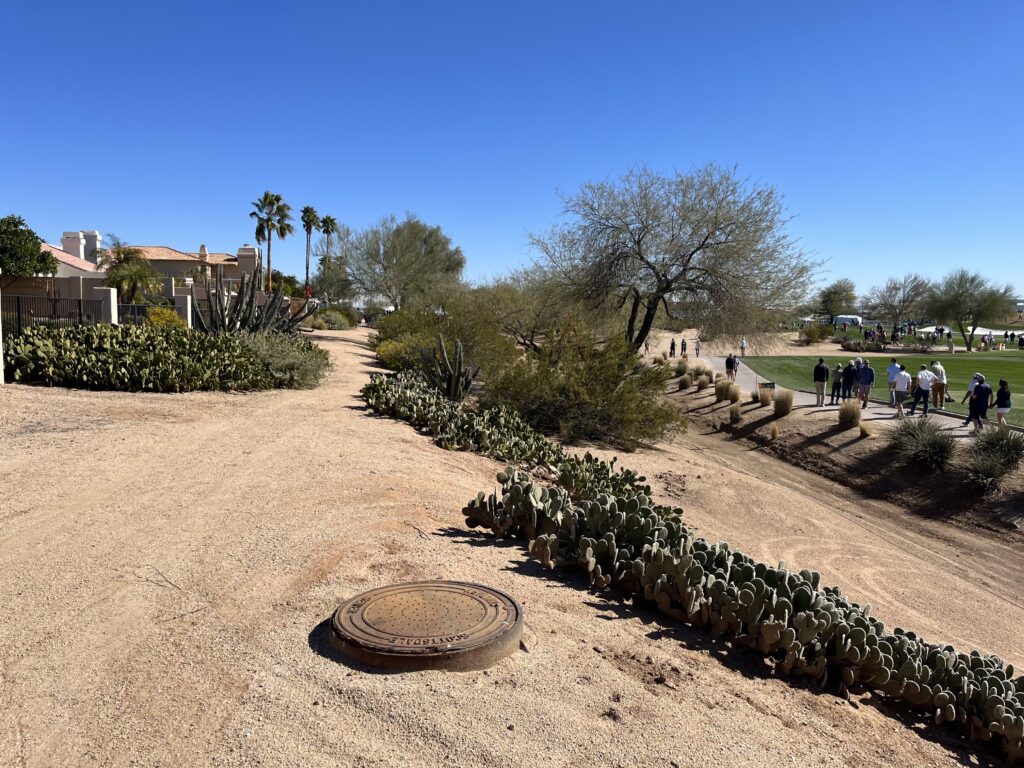
In gravity sewer design, context is crucial. While designing a pipe from point A to point B may seem straightforward, factors like location and timing can drastically complicate things. Such was the case with Dibble’s fast-paced sewer project at TPC Scottsdale. This upscale PGA Tour golf property is the home of the WM Phoenix Open, the best-attended golf tournament in the world. It is also the home of a critical 24-inch gravity sewer owned by the City of Scottsdale (City). To accommodate growth in the area, the City planned to supplement the capacity of the 24-inch sewer with a future sewer in the same area. But when plans emerged for a new DraftKings development on top of the existing sewer, the City knew it was time to act quickly.
Through proactive investigation, extensive coordination, and effective teamwork, Dibble carefully addressed multiple challenges. Our team worked closely with TPC, utility companies, permitting agencies, environmental specialists, and the DraftKings development to minimize impacts and keep the project on schedule, resulting in an action-packed, successful project.
ACCEPTING THE CHALLENGE
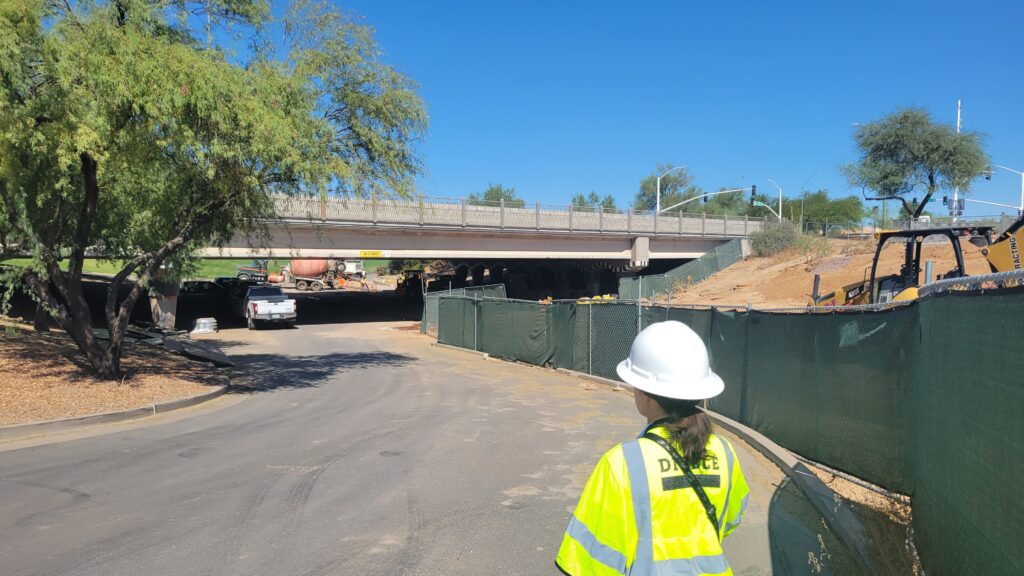
With the DraftKings development underway, the City needed to act fast to update their infrastructure. Their plan was two-fold: 1) rehabilitate the affected portion of existing 24-inch sewer, and 2) install an approximately 950-foot segment of the future sewer in the same work area. By completing this work before the DraftKings development was constructed, the City could preemptively protect its existing and new infrastructure while reducing impacts to stakeholders. This came with a few inherent challenges:
- Determining future connection points. The new 36-inch sewer segment would be installed before the future upstream and downstream sewers were even designed—a tricky situation for a gravity sewer with precise slope requirements.
- Navigating the maze of existing utilities. The project required numerous utility crossings, including a 66-inch raw water main, electrical duct bank, high-pressure gas main, storm drains, a large box culvert, and many others.
- Racing the clock. The new sewer needed to be constructed fast within a short window between the 2023 WM Phoenix Open and TPC’s fall operations, all while coordinating with the DraftKings
development in the same corridor.
Dibble addressed these challenges by methodically evaluating what needed to be done, and when, to keep the project moving forward as scheduled. With multiple stakeholders involved, early and continuing communication was essential.
DETERMINING FUTURE CONNECTION POINTS
For gravity sewers, the appropriate slope and alignment depend on the slope and alignment of the upstream and downstream connection points. Engineers must carefully design the slope of the sewer between these points (steep enough, but not too steep) to keep wastewater flowing downhill at acceptable velocities throughout the day. A minimum velocity of 2 feet per second is required to keep solids suspended in wastewater. If flows are reduced, solids can settle in the pipe, and a flow velocity of at least 3 feet per second is required to re-suspend them. Seemingly minor differences in slope can have a big impact on velocity and capacity, so careful analysis is crucial.
The City planned to construct a 2.5-mile 36-inch gravity sewer to supplement the 24-inch sewer, but the design for this future sewer had not yet begun. The new 950-foot segment (referred to as the Clubhouse Segment) is essentially in the middle of the future 2.5-mile gravity sewer; to design it, the team needed to first determine the overall alignment and slope of the 2.5-mile future sewer. Dibble promptly evaluated the preliminary route for the sewer and identified constraints that could affect the alignment.
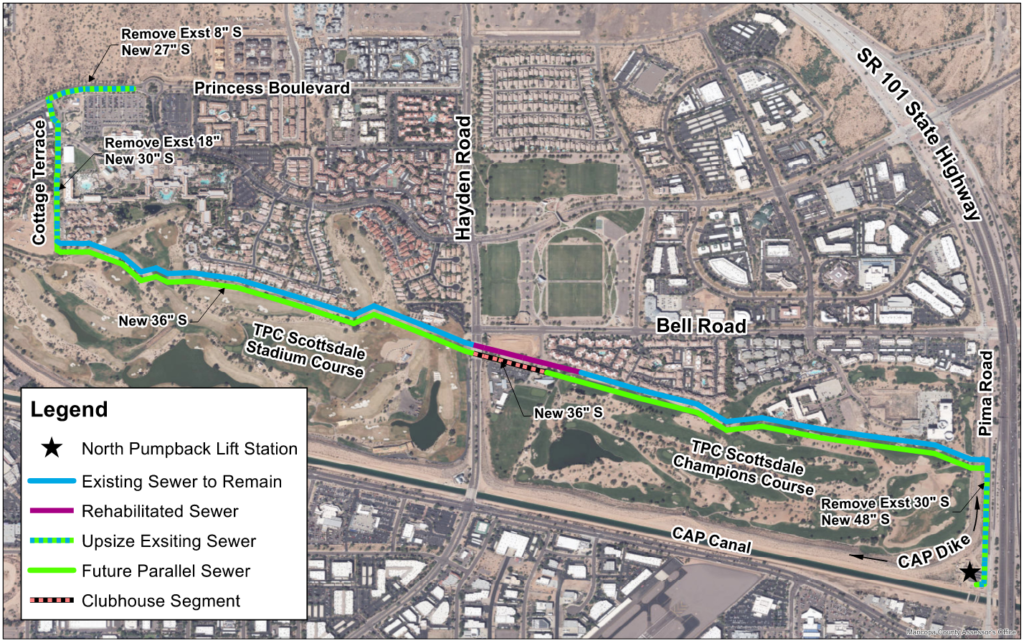
The preliminary route included several major stakeholders including TPC Scottsdale, Central Arizona
Project, U.S. Bureau of Reclamation, and the Arizona Department of Transportation, as well as multiple
major utilities. Unlike pressurized pipes, gravity sewers cannot dip and rise to avoid obstructions, so these existing utilities could significantly affect the alignment of the future sewer.
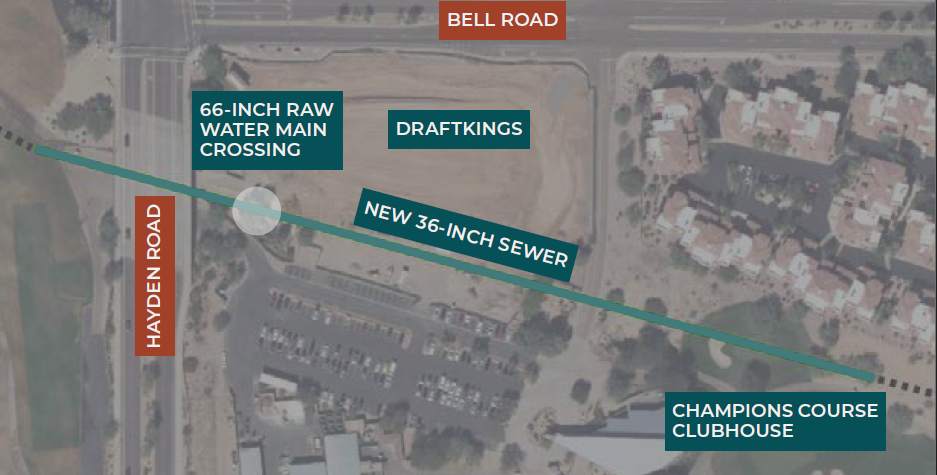
After analyzing the route, Dibble found that the alignment hinged on one major utility crossing: a 66-inch raw water main unavoidably crossed the future sewer alignment. To keep the project moving forward, the team needed to quickly determine the actual elevation and size of the pipe and decide whether to cross over or under it. This decision would affect the overall depth of the 2.5-mile future gravity sewer. Both options had pros and cons associated with other utility conflicts, connection
feasibility, constructability, stakeholder involvement, and cost. For example, a deep alignment
could avoid many utility conflicts, but a shallow alignment could provide better connectivity to the
existing sewers.
Th e City ultimately chose a shallower alignment that crosses above the raw water main. This timely and important decision allowed the team to proceed with design. For extra protection, the sewer was designed to be encased within a 54-inch steel casing as it crosses above the raw water main.
NAVIGATING THE MAZE OF EXISTING UTILITIES
Dibble held multiple meetings with utility owners to quickly assess and address the numerous utility conflicts. Many of these utilities needed to be relocated or realigned, including a 33-inch-tall concrete encased electrical duct bank, a communications duct bank, an 8-inch potable water main, and a 12-inch reclaimed water main. Early and continuing communication was crucial. To ensure the path was clear for the new sewer during construction, these utility coordination meetings continued beyond the design phase.
With so many crossing utilities, potholing was essential for design and was a significant effort within the limited time frame. During construction, the team discovered undocumented utilities, including an 18-inch storm drain, which the team promptly evaluated and rerouted. Because the team was in constant communication, unforeseen issues were quickly addressed. This effective collaboration kept the project on schedule.
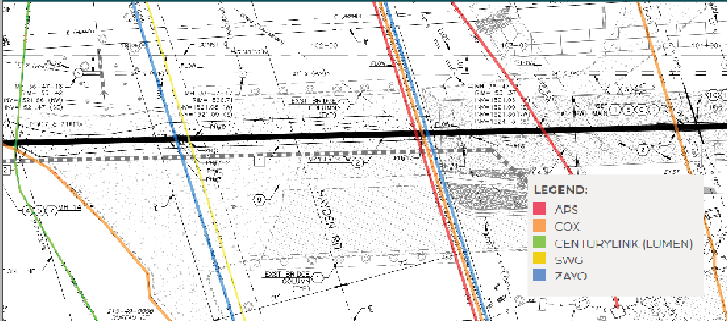
Extensive Utility Coordination: To coordinate efficiently with multiple affected utilities, the team used a color-coded utility crossings exhibit. Several major utilities needed to be relocated within the tight time frame—a significant task for utility companies. Dibble’s respectful, consistent communication was vital for success.
RACING THE CLOCK
From inception to conclusion, timing was a critical factor for this project. Though the DraftKings development was already underway, our project needed to be permitted and constructed first while integrating with DraftKings’ design, which included a new commercial building, roadway, parking, and drainage improvements. A major part of the drainage improvements was a 144-inch by 42-inch box culvert directly in the path of the new sewer.
The schedule was further constrained by the upcoming WM Phoenix Open, for which preparations had already begun. TPC planned to construct a large raised wooden walkway in November—directly over the path of the new sewer—to guide spectators to different areas of the golf course. This walkway would also cover the location of the 66-inch raw water main crossing, the actual depth of which was unknown. The walkway would remain in place until after the WM Phoenix Open in March. Construction of the new sewer would need to start immediately after the walkway was removed to be completed before TPC’s fall preparations began again.

These time constraints meant the team needed to think ahead, work together, and act fast:
- To keep the team informed, Dibble held weekly meetings with the City, the JOC contractor, and affected stakeholders for the duration of the project.
- Before the walkway was constructed, we immediately potholed the 66-inch raw water main to help determine the vertical alignment of the new sewer. This allowed design to proceed before and during the WM Phoenix Open.
- Shortly after the walkway was removed, we potholed the locations of multiple other utilities in the project corridor to finalize the design.
- We coordinated efficiently to construct the new sewer and place a concrete cap over it before the large new box culvert was constructed above it. Constructing the sewer first was critical for construction sequencing.
- By developing clear, technically sound plans with abundant utility crossing information, we expedited the construction process.
A COLLABORATIVE SUCCESS
This noteworthy project underscores the value of the following:
- Early and continuous communication with the owner, JOC contractor, stakeholders, and affected utilities.
- Proactive investigation—determining and obtaining the necessary information to reach critical milestones.
- Technically sound plans and reports that minimize questions and provide a clear path forward.
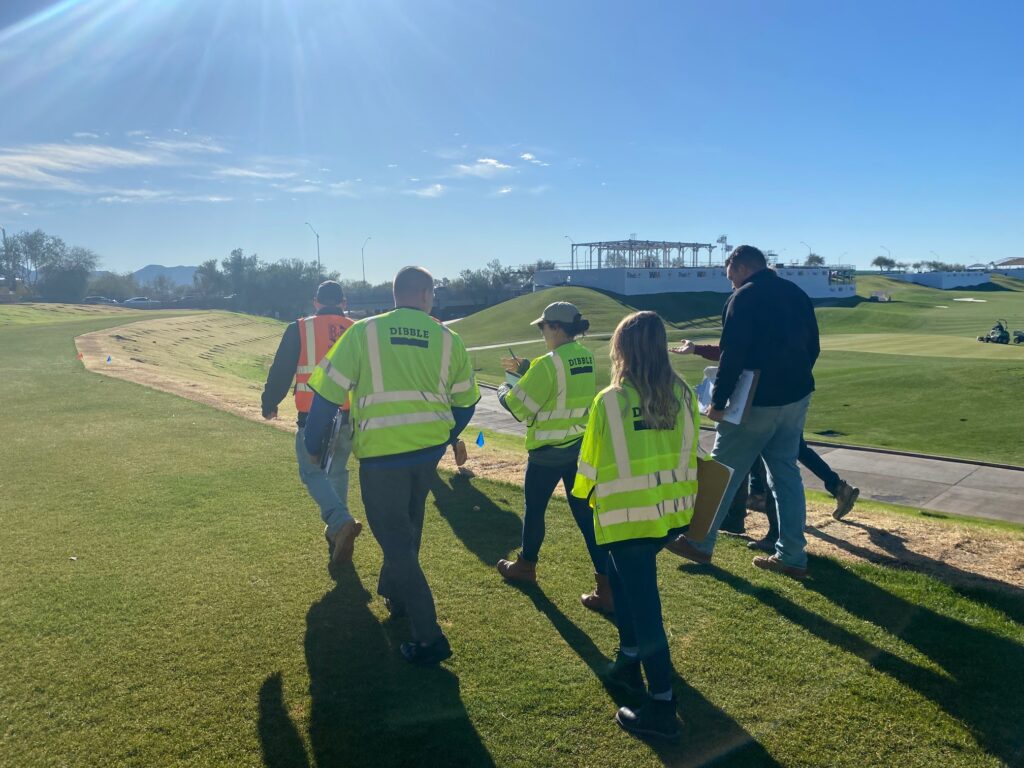
Our team successfully completed this fast-paced project on schedule, with no impact to the WM Phoenix Open. We coordinated effectively to meet stakeholder needs while providing critical sewer infrastructure for the City, enabling continued development for decades to come.
📄 Download the full Case Study PDF here


