

“Dangerous Intersections” and Access Control
Recently, I saw an article where the news agency ranked local “dangerous intersections” based on the number of crashes at each intersection. This type of ranking is neither appropriate nor accurate. Rather, the focus needs to be on serious injury and fatal crashes, but even then, this type of metric can have issues. The number of crashes at an intersection is driven by the volume of traffic and the type of streets involved. A higher traffic volume means more crashes, and arterial-to-arterial intersections also have more crashes.
All intersections can be dangerous because they allow for the possibility of right-angle (T-bone) crashes, which increase the risk of serious injury or fatal crashes. This risk becomes even higher if the intersection does not have a traffic signal because the likelihood of a high-speed right-angle crash is even higher. In reality, the most dangerous intersections are uncontrolled full-access intersections. This includes public street-to-street intersections and driveway-to-public street intersections. There are tens of thousands, perhaps millions, of these intersections in the United States. To develop a better rating of the most dangerous intersections, all these uncontrolled full-access intersections should be compared to those with traffic signals.
One would likely find that uncontrolled full-access intersections, if taken in their network total, have just as many or more serious injury and fatal crashes as signalized intersections. This issue is not specific to just one particular location or intersection in each city or town—it is a systemic street network problem where these types of intersections exist everywhere.
When I was with the Pima County Department of Transportation (PCDOT) in Tucson, AZ, our most dangerous intersection based on the number of fatal crashes was Trico Road and Trico Marana Road, where we had two fatal motorcycle crashes in less than five years. This is a very low-volume intersection in the middle of a rural area. If I recall correctly, on both occasions, a truck pulling a trailer did not fully stop at the stop sign on Trico Marana Road and went into the intersection, and the motorcyclist did not have time to stop to avoid a collision. To mitigate the cause of these crashes (drivers running the stop sign), we put up a bigger stop sign with red flashing beacons. In reality, this was only a band-aid solution, as it still relies on drivers to follow the rules of the road—coming to a complete stop and looking both ways to make sure the road is clear before proceeding. What we should have done is put in a roundabout, which would have eliminated the right-angle
collision potential and addressed the driver error issue of running the stop sign.
Another way to eliminate the potential for right-angle crashes, especially at uncontrolled intersections with arterial streets, is simply not to allow them or to cut them off with raised medians that make such movements physically impossible. This strategy enacts well-known access control principles to help reduce serious injury and fatal crashes caused mostly by right-angle crashes at intersections like these. If anyone has doubts about this statement, I urge you to obtain the Transportation Research Board (TRB) Access Management Manual, Second Edition, along with the companion Access Management Application Guidelines. Both documents
provide specific guidelines on how to approach the configuration and design of street networks, streets,
and driveways to provide effective and efficient access for all modes of travel. However, many of the TRB access recommendations are often ignored or blocked from being implemented—especially for existing conditions where allowing full access is known to be very dangerous. Instead, these existing accesses are often grandfathered in without regard to the crash risk or crash history. Due to this non-comformance with best practices and the perceived importance of left-out movements, many people are needlessly injured and killed every day in our nation. I often see drivers wait for several minutes before they finally get a gap to turn left. In terms of traffic engineering, this would be level of service (LOS) F—which is far less efficient and more
dangerous than right-out movements.
Right-angle crashes present the highest risk of serious injury or fatal crashes. Solutions such as roundabouts, raised medians, and traffic signals reduce or eliminate the potential for right-angle crashes, thus enhancing safety at intersections.
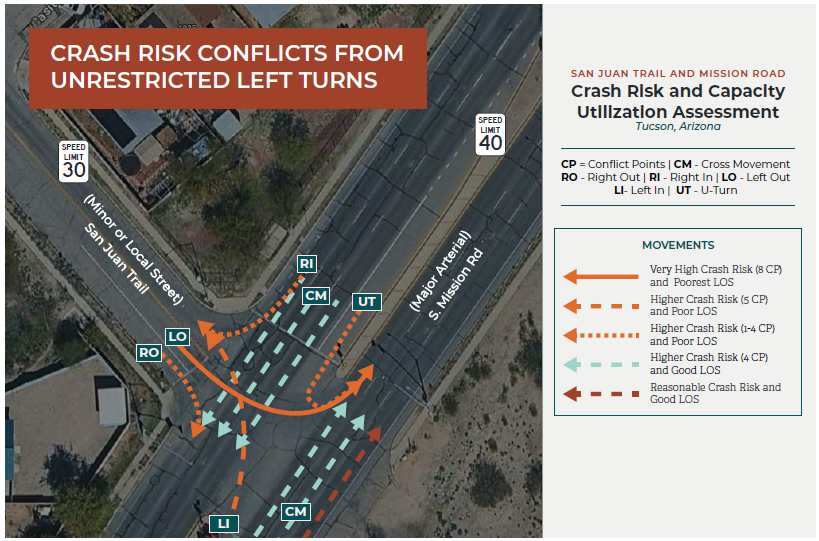
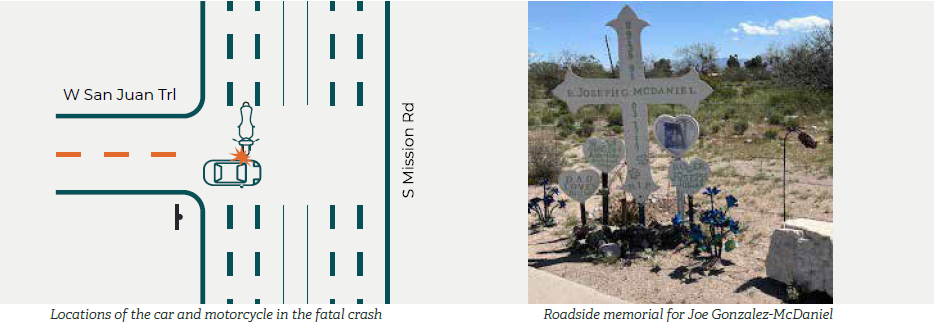
To help illustrate the danger of full access at arterial street intersections with minor streets or private driveways, I would like to share a personal story of tragedy. During my time as the PCDOT Traffic Engineering Division Manager, I managed the county’s pavement marking, traffic signing, traffic signals, and lighting maintenance crews. On March 17, 2017, one of my sign technicians, Roger “Joe” Gonzalez-McDaniel, was driving home from work on a motorcycle. As he was driving south on a major arterial (Mission Road), a vehicle turning left from a minor street (San Juan Trail) to go northbound on Mission Road pulled out in front of him. Joe attempted to stop but did not have enough time to do so and collided with the driver’s side of the other vehicle. Tragically, Joe was killed in the crash. The driver of the left-turning vehicle claimed he did not
see Joe. This intersection makes it difficult to for drivers on the minor street to turn safely, given the number of lanes on the major arterial and the high vehicle speeds.
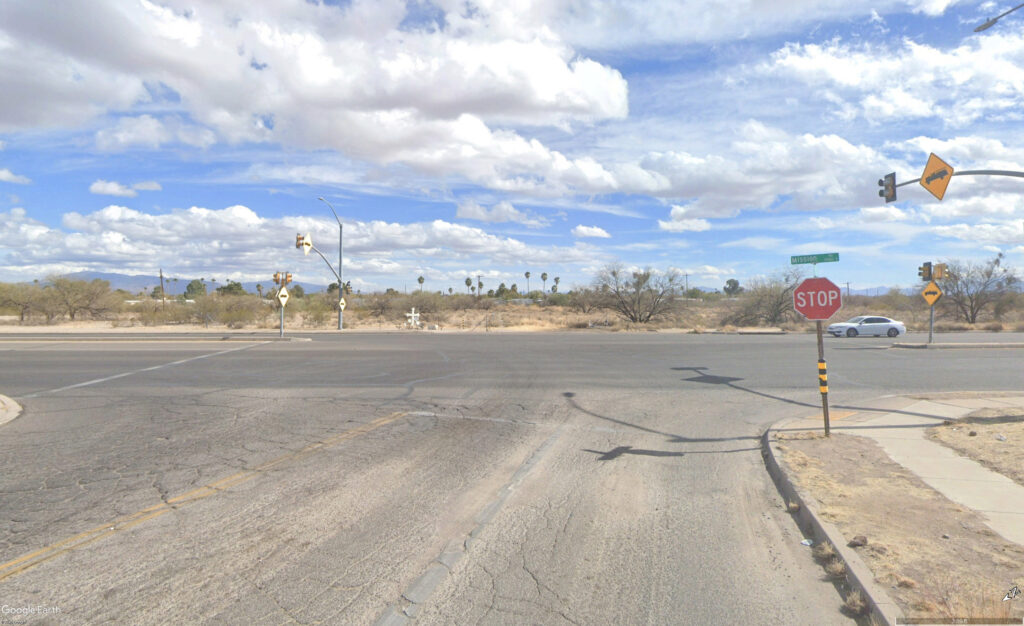
I believe this intersection is a prime example of the dangers of uncontrolled intersections, especially when they intersect with higher-speed, higher-volume arterials with many lanes. The photo below shows the full-access street-to-street uncontrolled intersection of San Juan Trail and Mission Road. The irony of this intersection is the presence of the emergency vehicle signal for Tucson Fire Station No. 15, which is just up the street on San Juan Trail and allows emergency vehicles to safely turn onto Mission Road from San Juan Trail. It seems the safety of left-turning fire trucks takes precedence over the safety of left-turning private vehicles.
Allowing left turns at this intersection is questionable, as it is hazardous due to Mission Road being six lanes wide, with a median, and on a curve. It is a defective design that completely ignores TRB’s recommendations and the high probably of driver error in misjudging a gap or not seeing a motorcyclist like Joe. The question becomes, why do we allow intersections like this? What if we prevented left turns at intersections like this? How many people like Joe have been killed at similar intersections? Even after Joe’s death, nothing has been done to mitigate the crash risk at this intersection caused by the left-out movement.
One of my most difficult assignments with PCDOT was helping Joe’s family clean out his desk. Joe was an energetic and hardworking young man and father who was taken from this world far too soon. I still mourn his tragic and senseless death caused by a poorly designed full-access intersection. With tens of thousands of these uncontrolled intersections across the U.S., Joe is one of countless individuals who are needlessly injured or killed at such intersections. This tragedy has driven my work as a traffic safety advocate and engineer. In advocating for safer traffic engineering design—including at unsignalized intersections—I hope to do my part in reducing deaths and serious injuries on roadways. We need to take action now to correct these dangerous
intersections to protect the safety and well-being of all road users.
📄 Download the full case study PDF here


