

Public Road Access Rights and Responsibilities
INTRODUCTION
Private and public access points are an important part of any roadway or street network. It is important to consider both the access rights on public roadways and the responsibilities of landowners and the public
jurisdiction with authority over the road or street from which access is achieved. Arizona Revised Statutes (ARS) Title 33. Property § 33- Access to Private Property states:
“A. Notwithstanding any other law, reasonable access to private property shall not be denied by this state or any political subdivision of this state.”
Political subdivisions of the state are counties or incorporated cities or towns. Access to a private property from a public street is commonly achieved by a private driveway or private street intersection. For the purposes of this paper, private driveways and street intersections are treated the same.
While access is a legal right, it also introduces challenging considerations related to traffic operations and safety. Vehicle access points, such as driveways and minor street intersections, can increase vehicle-to-vehicle conflicts, particularly those that result in angle, turning, and highspeed rear-end (RE) crashes. These types of crashes are among the most dangerous and can result in serious injuries or fatalities. Therefore, it is essential that access management strategies balance the right to access with public safety considerations and efficient traffic operations. This paper explores this balance, not only for new accesses but also for existing accesses that were previously granted.

THE DEFINITION OF REASONABLE ACCESS
A key provision of ARS § 33-2401 is the interpretation of what constitutes “reasonable access.” While the statute affirms that access to private property cannot be unreasonably denied or altered, it also implicitly recognizes the authority of the state and its subdivisions (i.e., counties, incorporated cities/towns) or jurisdictions to regulate how that reasonable access is provided. This reasonable access is typically codified in local municipal ordinances or codes in a chapter titled “Private Driveway Access to Public Roads” or something similar, then further supported by that jurisdiction’s development processes, design manuals, and standard drawings. These documents outline the technical and procedural requirements for accesses, including the configuration (allowed traffic movements), driveway spacing, traffic control, sight distance, and geometric design requirements that work together to provide reasonably efficient and effective access.
Both new accesses for new developments and existing accesses for redevelopments often require a traffic study to determine how that access might operate and what improvements might be needed to balance the legal right of access with safe, effective, and efficient traffic operations. Depending on the size of the development or redevelopment and the amount of traffic it might generate, the study might also analyze other driveways and street intersections.
The scope of these traffic studies is typically set by the jurisdiction that has control of access authority based on their specific criteria. For most municipal streets such as arterials, collectors, and local streets, an incorporated city or town is typically the control of access authority. In unincorporated areas, the control of access authority may be the county, state, tribal, or federal government or a combination thereof, depending on who owns and operates the roadway being accessed. If the roadway is within tribal lands, it may be subject to the specific requirements of the tribe or the Bureau of Indian Affairs (BIA); ARS § 33-2401 does not apply in these situations, as the tribe has sovereignty. A discussion of tribal and BIA requirements is beyond the scope of this paper.
An important exception to this authority is for portions of highways (especially freeways) that are under the jurisdiction of the State of Arizona. For Arizona state highways and freeways, this authority belongs to the Arizona Department of Transportation (ADOT). Typically, ADOT requirements prevail over municipal requirements within ADOT right-of-way (ROW) unless otherwise approved by ADOT. When gaining new access, it is important to confirm which governmental jurisdiction(s) have the control of access authority. It is also important to note that reasonable access does not mean that the location and configuration of existing driveways are permanently exempt from future changes, especially if the driveway presents safety or operational issues. Under ARS § 33-2401, the State of Arizona and its political subdivisions retain the authority to re-regulate new and reregulate existing driveways to help them meet current planning and engineering safety and operations standards. This right is granted through Provision D of ARS § 33-2401, which states:
“D. Following reasonable consultation with the owner of the private property, this state or any political subdivision of this state shall determine the appropriate location and width of the right-of-way to be granted and may relocate the right-of-way after the grant at the discretion of this state or the political subdivision of this state.”
This means that existing driveways will not necessarily be grandfathered in and can be changed if there is a good reason to change it. The full ARS § 33-2401 can be found at this link https://www.azleg.gov/ars/33/02401.htm or by scanning the QR code below.

DRIVEWAY MOVEMENTS AND CONFLICTS
Driveways create conflicts for traffic entering and exiting them, which impact the effectiveness and efficiency of traffic on the street. Not only do the State of Arizona and its subdivisions have a duty to maintain the reasonableness of driveways’ right to access, but they also have a basic duty to keep its roadways reasonably safe for ordinary travel and without an unreasonable traffic operations impact to new or existing streets or other accesses.
While the jurisdiction’s duty to provide reasonable access and reasonably safe roadways should go hand in hand, unfortunately that is not always the case. Even though this basic duty to provide reasonably safe roadways should be considered within the definition of reasonable access, ARS § 33-2401 does not mention safety at all. The challenge with driveway design is to keep these impacts to a reasonable level that meets the need for private property access while maintaining the basic safety, effectiveness, and efficiency of the street.
The spacing, number, and type of driveways and the movements allowed to and from the street largely depend on the functional classification of that street and the potential impacts of the driveway on the street. Thus, the need for access and the amount of access allowed must be carefully balanced so the integrity of the public street and other existing accesses is not compromised by the amount of access (or movements) allowed at that driveway. Key factors include the posted speed limit, number of lanes, traffic demand, and functional classification of the street.
Access is a function of driveway spacing and the number of access points along a given portion of a street. The amount of access allowed refers to the movements allowed in and out, specifically at that driveway. Each driveway can have up to five direct movements: Right in (RI), right out (RO), left out (LO), left in (LI), and cross movements (CMs). Full-access driveways allow all possible movements and can be problematic due to their crash potential, especially on multi-lane arterial streets.
A restricted-access driveway may limit one or more of these movements, thereby reducing some potential conflicts. The restricted movements often depend on the location of the driveway and the functional classification of the street to which the driveway provides access. Additionally, how much access is allowed may depend on the timing of other adjacent improvements. For example, a full-access driveway might be allowed during an interim period until one or more movements may need to be restricted due to adverse impacts those movements might create to the new development that has just been built. New full-access driveways should be avoided wherever possible, and existing full-access driveways should be retrofitted to eliminate the CM at a minimum.
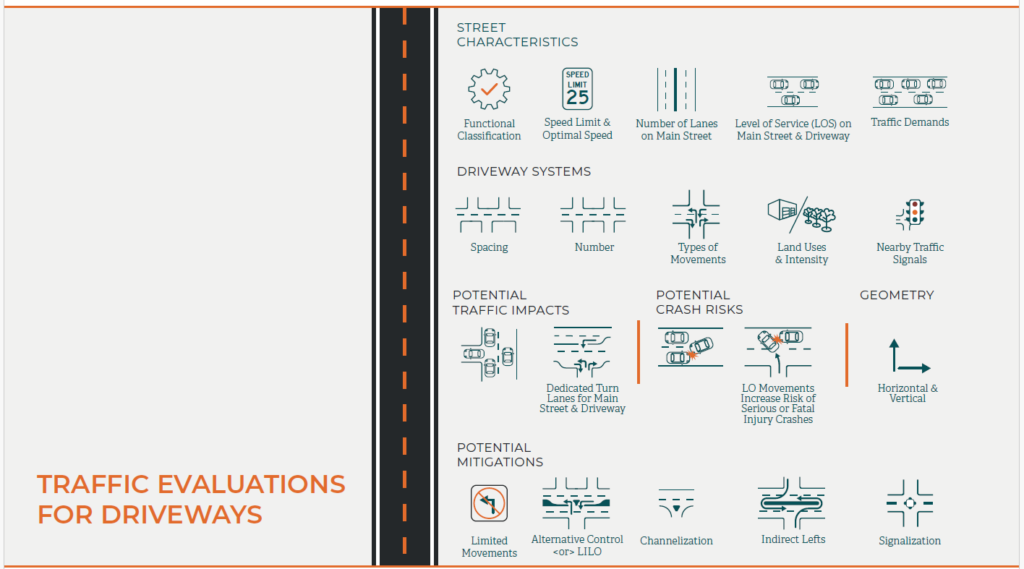
THE IMPORTANT OF TRAFFIC AND SAFETY ANALYSES
When new driveways are planned or existing ones are revised, many in the traffic engineering field focus primarily on the vehicle trip generation and traffic volume impacts while overlooking the potential safety implications of the new access and the additional traffic it will generate—including pedestrians and other vulnerable road users (VRUs).
Traffic Impact Statements and Analyses
A typical traffic impact statement (study) or analysis (TIS or TIA) estimates the number of vehicle trips generated by the proposed development, how those trips will be distributed and assigned across the surrounding roadway network, and what operational impacts this new vehicle traffic demand may have. New pedestrian and VRU demand is rarely included, especially in rural communities.
To support these vehicle-focused studies, existing traffic volume data are collected—typically during peak weekday morning and afternoon periods—to establish a baseline of current traffic conditions. This allows for a comparison between existing (background) conditions and the projected impact of the new development. The analysis includes capacity and delay metrics, often expressed in terms of queued vehicles, added delay, and LOS ratings for key intersections and roadway segments. These quantitative outcomes often serve as triggers to identify what improvements are needed to address existing deficiencies or to mitigate the impacts of new traffic. Defining background conditions is a critical component of any TIS or TIA, as it helps distinguish between mitigation responsibilities related to the development versus those related to existing conditions.
These analyses are conducted using methodologies from the Transportation Research Board’s (TRB’s) Highway Capacity Manual (HCM), which sets the national standard for evaluating traffic operations. Additionally, the Institute of Transportation Engineers (ITE) provides essential resources such as the Trip Generation Manual and Trip Generation Handbook, which are used to estimate trip generation based on land use type, size, and other characteristics. ITE also offers guidance on trip distribution, assignment, and mitigation strategies. These resources, along with applicable state, county, and municipal requirements, form the foundation of TIS/TIA methodology. In Arizona, ARS § 33-2401 establishes the legal foundation allowing state and local agencies to require these studies, as it specifies that reasonable access cannot be denied; therefore, the studies are used to determine what reasonable means.
Following the operational analysis, a before-and-after comparison—sometimes including future growth scenarios—is conducted to assess how additional traffic will affect roadway and intersection performance. Based on these findings, an improvement evaluation is performed to identify any necessary on-site and off-site mitigation measures to maintain acceptable traffic operations and LOS.
The Safety Gap
While the operational impacts of driveways are thoroughly analyzed in the TIS/TIA, the traffic safety impacts are often underemphasized. Only a few local jurisdictions in Arizona require a formal safety analysis or crash history review as part of the TIS/TIA process. Even when such reviews are conducted, they often result in a simple reporting of crash counts and types, rarely leading to the recommendation or implementation of proven safety countermeasures unless explicitly required by the agency with access authority.
Currently, ADOT and most jurisdictions in Arizona do not have a formal safety evaluation requirement as part of their TIS/TIA processes. As a result, it often falls to regional traffic engineers, district engineers, local traffic engineers, or proactive engineering consultants to take the initiative to recommend safety countermeasures. However, these efforts are frequently met with resistance from developers. Those advocating for safety improvements are sometimes overruled, which allows developments to proceed with minimal or no safety mitigations.
This reliance on initiative is not a sustainable approach to integrating safety into access decisions. There is a clear need for a formalized process that places safety on equal footing with traffic demand when determining reasonable access.
Proven Safety Countermeasures and the Safe System Approach
Dedicated turn lanes are an example of a measure that has been shown to improve safety at driveway intersections. However, the decision to require dedicated turn lanes is often based solely on volume warrants. If the volume threshold has not been met, turn lanes may not be required, even though the Federal Highway Administration (FHWA) has identified dedicated left- and right-turn lanes at intersections as a proven safety countermeasure (PSC). According to FHWA, these treatments can significantly reduce crashes, especially rear-end and angle crashes.
Even more compelling is FHWA’s PSC on corridor access management, which demonstrates how strategic control of access points can reduce crash frequency and severity while improving traffic flow. This countermeasure is part of a broader initiative of 28 PSCs that FHWA encourages agencies to implement as part of the Safe System Approach (SSA), which is the U.S. Department of Transportation’s framework to design roadway systems to prevent fatal and serious injuries even when human error occurs.
It is difficult to imagine how Arizona can fully achieve the goals of the SSA, the Arizona Strategic Highway Safety Plan, or other safety initiatives without requiring formal safety evaluations in all TIS/TIA processes, especially given that much of the state’s new roadway infrastructure is being built or rebuilt through development-driven projects.
Best Practices and Standard of Care
Best practices and standard of care in traffic and civil engineering increasingly recommend incorporating safety performance evaluations using tools such as the American Association of State Highway and Transportation Officials (AASHTO) Highway Safety Manual (HSM), TRB Access Management Manual, and TRB Access Management Application Guidelines. These resources demonstrate how new access points should be planned and designed to result in reasonable safety for all road users, including pedestrians, cyclists, and other VRUs.
This delicate balance of reasonable access and reasonable traffic operations and safety should be based on quantitative reasoning. This is why it is so important to analyze both traffic and safety operations through the applicable TIS or TIA processes. While a jurisdiction with access authority cannot deny reasonable access, it can regulate access to ensure reasonable traffic flow and safety for both the driveway and the street it accesses. The next section discusses general guidelines for driveway design, specific criteria and requirements, and potential driveway impacts in light of these reasonable traffic flow and reasonable safety principles.
GUIDELINES FOR DESIGN
General Guidelines
As already discussed, access rights are not unlimited. Each driveway that accesses a street needs to meet certain criteria and requirements. These are first divided by the type or functional classification of the street from which it will gain access, then by the development’s or site’s land use type. In cases where exceptions may be desired, the involved jurisdiction must discuss and approve the criteria.
- The main street functional classifications are local streets, collector streets, and arterial streets.
- The main land use divisions are residential and commercial/industrial.
Sometimes a street functional classification system may differentiate between major and minor collectors and arterials; if the jurisdiction makes this distinction, some of the requirements discussed here may vary. Regardless, for street classification divisions, the type of driveway, location, spacing, allowed movements, and potential required mitigations are the main criteria. For land use, the two designations are further divided based on the basic intensity of those types of developments or sites (e.g., single-family, multifamily, single business, multiple businesses).
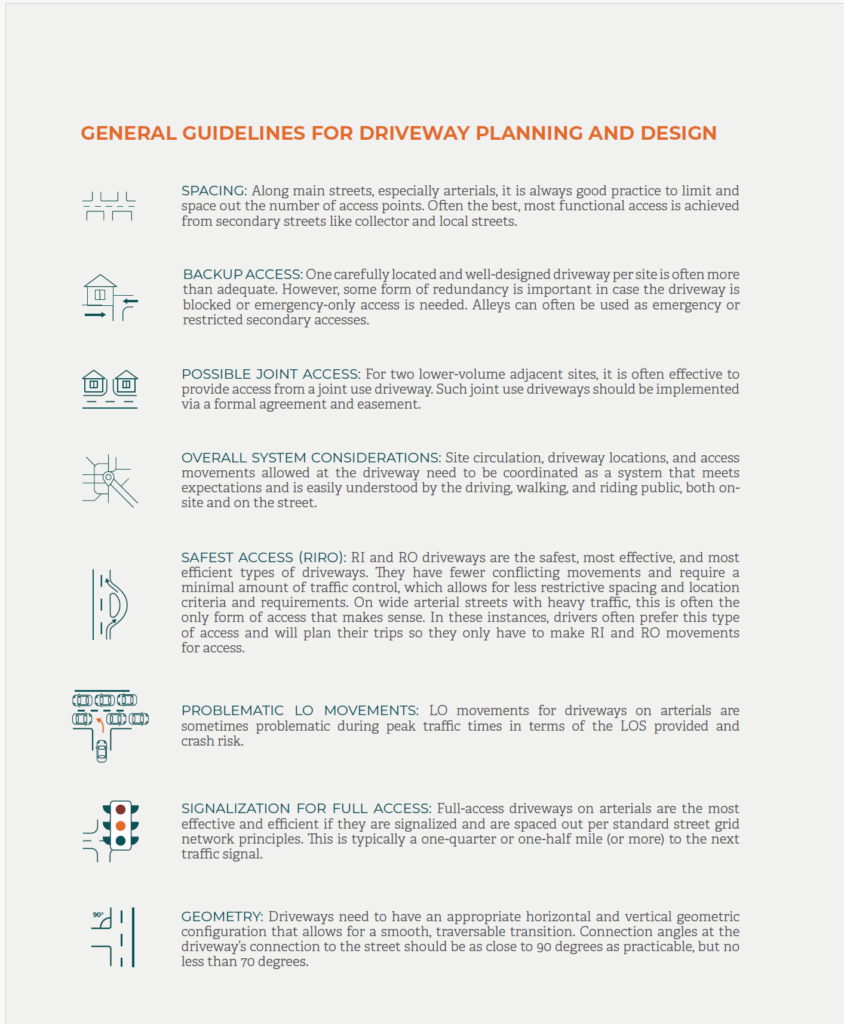
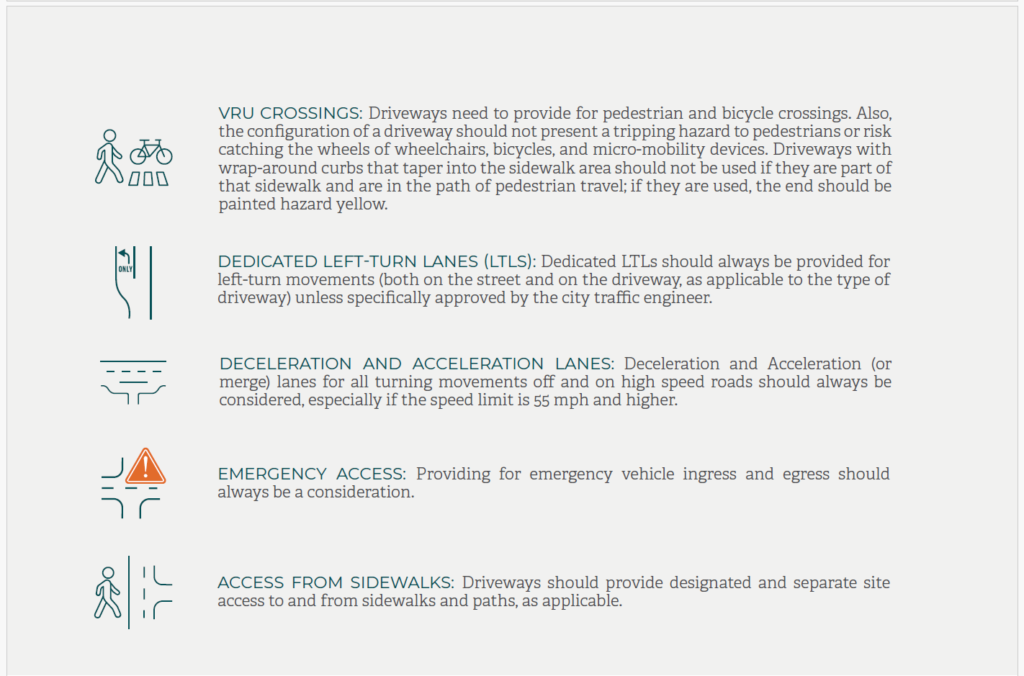
Driveway access on local streets with single-family homes is fairly straightforward. Depending on the type of residential development, the single-family home criteria can be used for duplex, triplex, or similar density residential housing with access provided off a local street. The multi-family requirements are targeted at low-intensity townhouses, condominiums, or apartment buildings that are typically fewer than five stories high and where traffic generation can be handled by local streets. High-density residential development (five or more stories, with or without parking garages) is treated similarly to the single or multiple business criteria, given these sorts of developments typically gain their access from collector and arterial streets. For planned industrial or commercial developments that use a local street configuration, the driveway spacing and locations can vary. Genral guidelines for driveway planning and design are as follows:
Specific Criteria and Requirements
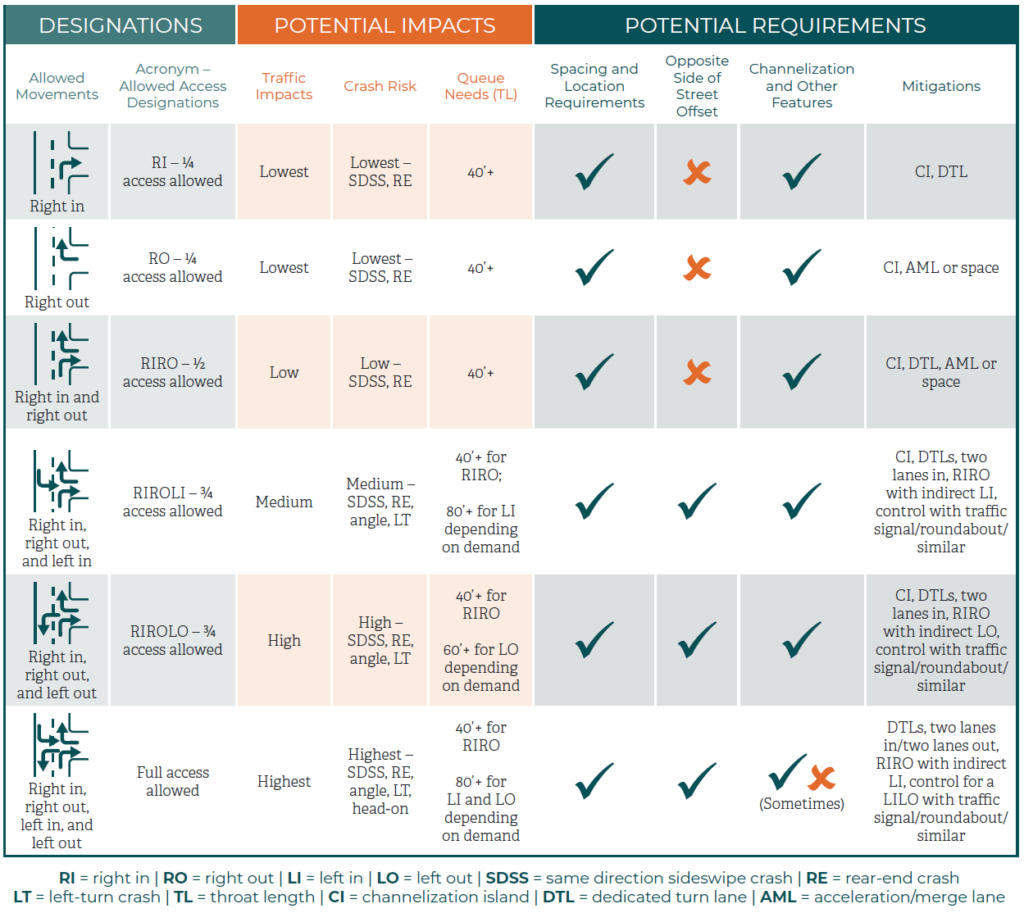
The following table and sections present more specific criteria and requirements for driveways on collector and arterial streets, including the types of access allowed (designations), potential impacts, and potential requirements/mitigations.
COLLECTOR AND ARTERIAL DRIVEWAY DESIGNATIONS, IMPACTS, REQUIREMENTS, ANS MITIGATIONS
Potential Impacts
Traffic Impacts
Traffic impacts refer to the impacts of the driveway on the collector or arterial street’s traffic flow and how much control might be needed at the driveway if traffic demand is high. These traffic impacts largely depend on the amount of traffic the site generates, the peak times for that traffic, and the background traffic on the street being used for access. The criteria for the rankings in the table (lowest to highest) are based on the following requirements:
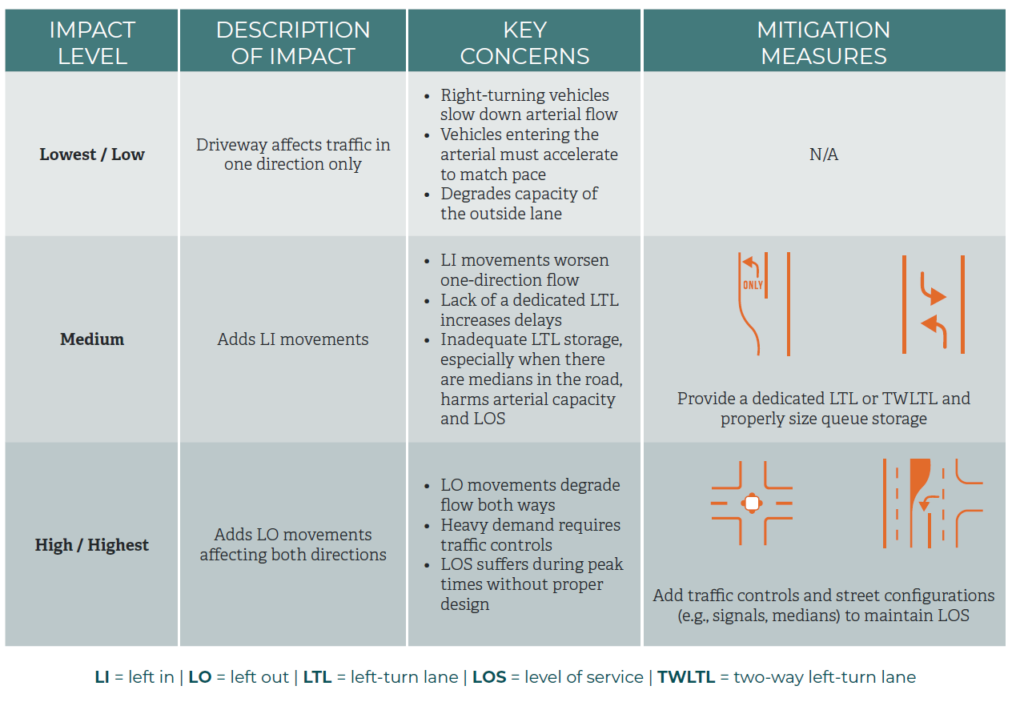
Cross Movements (CM) should typically not be allowed on arterial streets that have two through lanes in each direction. Allowing a CM in a situation like this is typically presents an unacceptable crash risk. Collector streets or local streets with one lane in each direction allowing a CM is typically acceptable.
It is important to complete a traffic capacity analysis using principles from the TRB HCM or a similar guideline, which better quantifies the potential traffic impacts and what movements will function at an acceptable LOS. The traffic capacity analysis also determines whether each movement should be allowed or whether it needs to be mitigated with some form of traffic control, such as channelization.
Crash Risk Impacts
Crash risk impacts are caused by the vehicle-to-vehicle, vehicle-to-pedestrian, and vehicle-to-bicyclist conflicts that the allowed movements create. The more movements allowed, the higher the crash risk potential. The type of conflict increases the potential severity of the crash risk; for example, left-turn movements that involve potential angle, turning, and head-on crashes have the highest potential severity, especially if they happen at high speeds. Thus, it is important to provide needed access without unduly creating more potential crash risks than necessary. For driveways, the primary crash types are same direction sideswipe (SDSS), rear-end (RE), angle, and turning crashes, while headon crashes are less likely. The criteria for the rankings in the table (lowest to highest) are based on the following requirements:
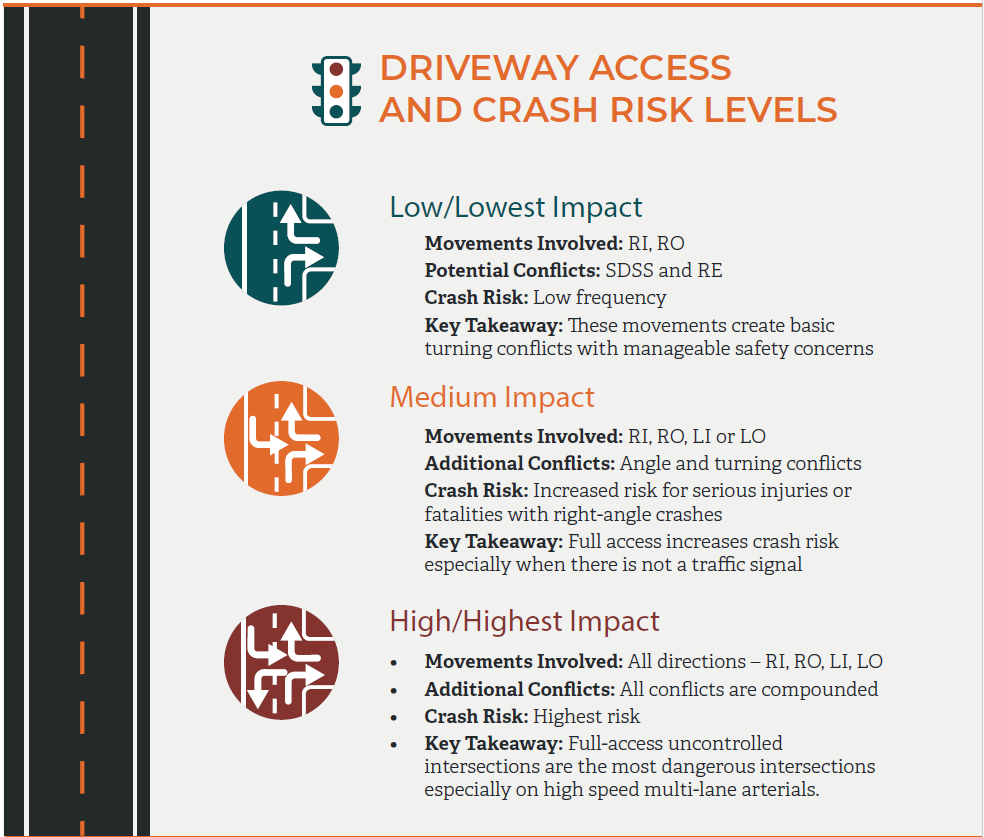
Some form of safety evaluation is highly beneficial to quantify crash risk and evaluate potential mitigations, especially on arterial streets. Crash frequency is a function of traffic demand—the higher the traffic volumes, the higher the likelihood of more crashes. Likewise, crash severity is a function of speed—the higher the speed, the higher the likelihood that some of those crashes will be more severe. Certain mitigations such as roundabouts, reduced movements, raised medians, and channelization reduce the right-angle collision potential, thus enhancing safety. Despite evidence-based industry guidelines for safe and effective access control, these guidelines are sometimes ignored for new intersections, and existing full-access interactions are grandfathered in regardless of a poor crash history. Uncontrolled intersections and driveways adjoining higher-speed, higher-volume, multi-lane arterials present the most dangers, especially when full access is allowed from the driveway.
Queue Needs
Given that left-turn access in and out of a driveway is typically important, that left-turn access will sometimes need a sufficient queuing area so vehicles can properly wait to turn in or out of the development. This queue length depends on the type of traffic control at the intersection. A minimum throat length (TL)—which is the distance between the edge of the pavement of the adjacent street and the end of the driveway inside the development—must also be provided for all driveways. The minimum for RIRO driveways is 40 feet or more, unless analysis shows the need for more. A queueing analysis will determine the queueing needs for turn lanes and TLs for all driveways.
Potential Requirements
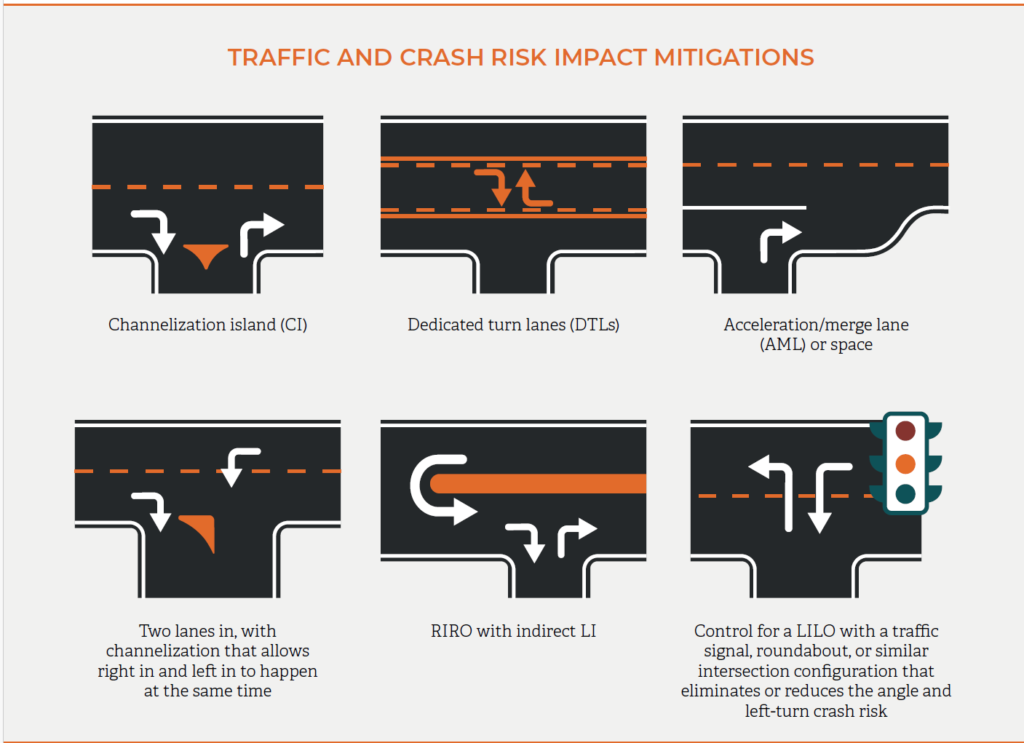
Possible mitigations to address the traffic and crash risk impacts of a driveway include the following:
These requirements can be applied to both on-site and off-site improvements. The jurisdiction with authority has the final say in approving the mitigations, including determining the driveway location, final configuration of the driveway and street, and traffic controls (if any). Though many municipalities do not have standards for these potential mitigations, other municipalities and ADOT do have standard details for these requirements. Any custom designs needed under special circumstances will be subject to review and approval by the jurisdiction with authority.
Benefits of Deceleration Lanes
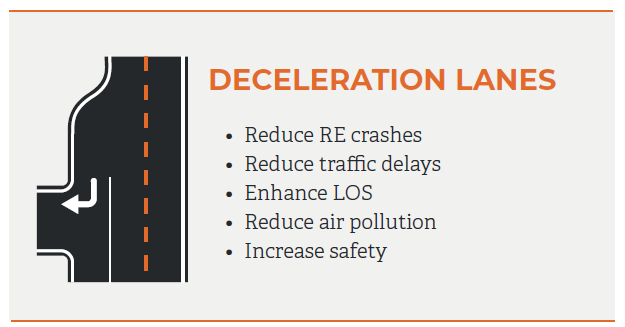
Deceleration lanes or right-turn lanes (RTLs) offer proven safety benefits. AASHTO’s 2010 version of the HSM states that RTLs can significantly reduce crashes, as detailed in the crash modification factors (CMFs) on the FHWA-sponsored Crash Modification Factors Clearinghouse website. RTLs typically reduce the occurrence of RE crashes. Various CMFs can be applied to the safety benefits gained by RTLs. Per the CMF Clearinghouse, the CMF used for RTLs is 0.7, which means that RTLs have the potential to reduce RE rashes of all severities by 30%. Although RE crashes are often less severe (most are property damage only), the risk of a high-speed-differential RE crash is very much a danger and can be very severe on higher speed arterial streets. Thus, providing RTLs at driveways on arterials needs to be evaluated from both traffic demand and safety viewpoints.
RTLs can also help reduce delay and keep a street at a better LOS. Less delay and better LOS are advantageous to road users (less time stuck in traffic) and the environment (less air pollution). RTLs also help mitigate side friction to traffic flow in the outside lanes caused by vehicles slowing to turn right onto side streets or driveways. This can become an issue if a high percentage of the turning traffic is large vehicles such as buses, delivery trucks, and freight trucks.
Another potential benefit of dedicated RTLs is that they can be used for bus stops. The National Association of City Transportation Officials (NACTO) recommends that RTLs be considered on streets that do not have dedicated transit lanes per their Transit Street Design Guide, calling these “shared transit/RTLs.”
FINAL WORDS ON ALLOWED MOVEMENTS
The bottom line for providing a driveway which provides reasonable access and safety is to keep in mind what risks those movements bring and how important those movements are as it is often more effective and efficient to take a route that might be a little longer, but in reality will involve less risk and perhaps less wait time (e.g. Level of Service).
Cross Movements Are the Most Dangerous
These movements involve multiple angle conflict points, exposure to high-speed traffic, and require
drivers to make split-second decisions to judge gaps and execute maneuvers safely. According to human factors research, gap acceptance and decision-making under time pressure are highly error-prone, especially when visibility is limited, speeds are high, and there are a lot of lanes to cross. At night, visual perception and reaction time degrade, increasing the likelihood of misjudging speed and distance, a key contributor to angle crashes, which are among the most severe in terms of injury and fatality risk. These movements also suffer from poor level of service due to long wait times, which can pressure drivers into unsafe decisions (shoot a gap without fully assessing the risks).
Left Turns (Especially Left Out) Are Next in Severity
These movements often require drivers to cross multiple lanes of fast-moving traffic, demanding accurate gap judgment and timing. Studies show that older drivers, fatigued drivers, and those under stress are more likely to make errors in left-turn decisions, particularly when headlights or glare reduce visibility and ability for drivers to judge gaps and the oncoming speed of opposing vehicles. These movements also suffer from poor level of service due to long wait times, which can pressure drivers into unsafe decisions (shoot a gap without fully assessing the risks).
Right Out Movements Can Be Deceptively Risky
While they may seem simple, RO movements onto high-speed highways without acceleration lanes expose vehicles to rear-end crashes and side-swipe risks. Human factors research highlights that drivers entering high-speed traffic from a stop face cognitive overload, especially when merging under pressure. Without acceleration lanes, drivers must rapidly accelerate while scanning for gaps, a task that becomes significantly harder at night or in poor weather. Acceleration lanes can also be important for large vehicles, vehicles with trailers and heavy trucks.
Right In Movements Are Generally Safer
These movements typically involve fewer conflict points and occur at lower speeds, especially when entering from local roads from a dedicated right turn lane. However, even these can pose risks if sight distance is limited or if the receiving lane is congested. Nighttime conditions can still impair visibility, hence why it is good idea to provide lighting not only in the intersection area but on the
approaches as well, but the relative simplicity and lower speed of RI movements reduce the severity of potential crashes or the chance the crash will even happen.
CONCLUSION
Public access between streets and driveways is a complex and important subject that directly impacts residents’ and commuters’ safety, well-being, and quality of life. Jurisdictions have a responsibility to provide access from arterial, collector, and local streets to businesses and residential areas. The goal is to provide reasonable access that minimizes traffic and safety impacts while meeting queueing needs.
Determining the location, spacing, and number of driveways and the access allowed at each one
is a delicate balance guided by the jurisdiction’s guidelines, industry standards, and current recognized best practices. This is especially true with existing driveways—just because a driveway exists in a certain configuration in terms of its location and allowed movements does not mean it has to stay that way if there is good reason to change it. Key factors include the characteristics of the adjacent street, such as the posted speed limit, number of lanes, traffic demand, functional street classification, and peak traffic. It is also imperative to consider the site as a whole, including the driveway access system, site circulation, surrounding land uses, pedestrian/bicyclist crossings, and geometric configuration.
Driveway design must carefully consider how the driveway would cause resistance to the flow of traffic in one or more directions and the crash risk impacts of different movements. Mitigations are a key component of the design process, leveraging strategies such as channelization, DTLs, traffic controls, and limited movements to enhance safety for drivers and VRUs alike. Deceleration lanes (RTLs) are a proven strategy for improving LOS and safety on arterials with numerous driveways.
Though driveway design may appear to be simple on the surface, in reality, it requires an intricate attention to detail and street design principles. The goal is to balance reasonable access with reasonable safety while preserving the function of the adjoining street.
📄 Download the full case study PDF here


