

Building Capacity and Resilience: Chandler’s 66-Inch Sewer Interceptor Rehabilitation
Contributors/Acknowledgments:
Melanie Sikes, PE, City of Chandler
Katie Gaul, PE, City of Chandler
Ezra Page, PE, Dibble
Amit Satre, PE, B&F Contracting
Heather Brown, Dibble
Beneath the steady hum of a bustling business corridor in Chandler (city), a 66-inch sewer interceptor quietly does its work. This critical sewer was installed in the 1980s and showed signs of deterioration. An expiring lease agreement with a nearby wastewater reclamation facility amplified the need for prompt rehabilitation, as millions of gallons of wastewater would soon be redirected into the city’s system. To accommodate additional flows and continued development in the highly traveled corridor, the city took action to rehabilitate the sewer with as little disruption as possible using trenchless technology. The project came with several challenges:
- Numerous Stakeholders: Stakeholders included facilities for microchips, aerospace, financial services, data centers, and an electrical substation, all of which required continuous service and access.
- Significant Traffic Control Needs: The 66-inch sewer is located along Price Road, a busy six-lane arterial that intersects the SR 202 and SR 101, surrounded by industry and ongoing development. Traffic lane restrictions required night and weekend work.
- Temporary Construction Easements (TCEs): To reduce traffic control impacts and avoid significant utilities in the right-of-way, the team needed to obtain six TCEs for the temporary bypass pipes and pumps. These required considerable coordination with landowners, cost more than $1M, and took more than a year and a half to obtain.
- Hydraulic Constraints: The 66-inch sewer has a relatively flat slope, such that a slight decrease in the inside diameter (due to lining) could reduce capacity. A hydraulic analysis was required to confirm that the sewer’s capacity would remain within acceptable limits.
- Extensive Wastewater Bypass: For nearly 18 months, a substantial 20 million gallons of wastewater needed to be bypassed daily—enough to fill about 30 Olympic-sized swimming pools each day.
Through a collaborative Construction Manager at Risk (CMAR) delivery process, Dibble, the city, and B&F Contracting worked together to address each of these challenges, resulting in a successful, noteworthy project.
Cured-in-Place Pipe (CIPP) Rehabilitation
Given the sewer’s location and capacity needs, the city opted to rehabilitate the 66-inch sewer with 12,867 linear feet of water-cured CIPP lining. This approach provided the following advantages:
- Reduced the excavation footprint
- Resulted in a fast installation
- Restored structural integrity – a fully deteriorated liner was specified
- Provided corrosion and root resistance
- Preserved the existing alignment with minimal capacity reduction
- Lowered the lifecycle cost in comparison to open-cut replacement
- Provided environmental benefits – lower carbon emissions and less disruption
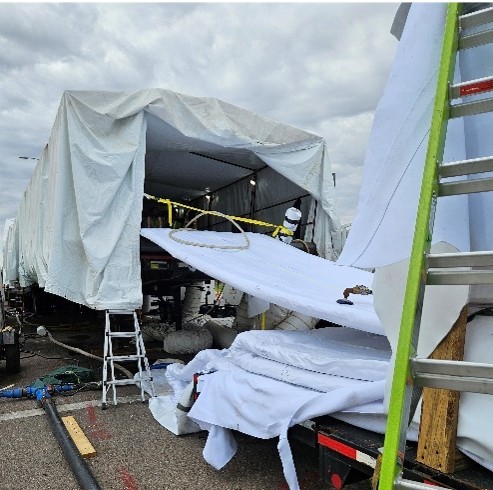
The team partnered with SAK Construction, leveraging their trenchless expertise during preconstruction and construction. Dibble designed a phased approach for installation, minimizing the number of CIPP shots and insertion/termination pits. The sewer is 30 feet deep, so reducing the number of pits significantly decreased excavation impacts. The team designed pit locations based on feasible CIPP shot lengths (averaging 1,100 feet for this project), the sewer’s geometric layout, existing infrastructure, and stakeholder needs in the surrounding areas. The construction duration of each liner shot took approximately one week. Dibble’s rehabilitation specialist inspectors were onsite to provide quality control and critical inspection hold points.
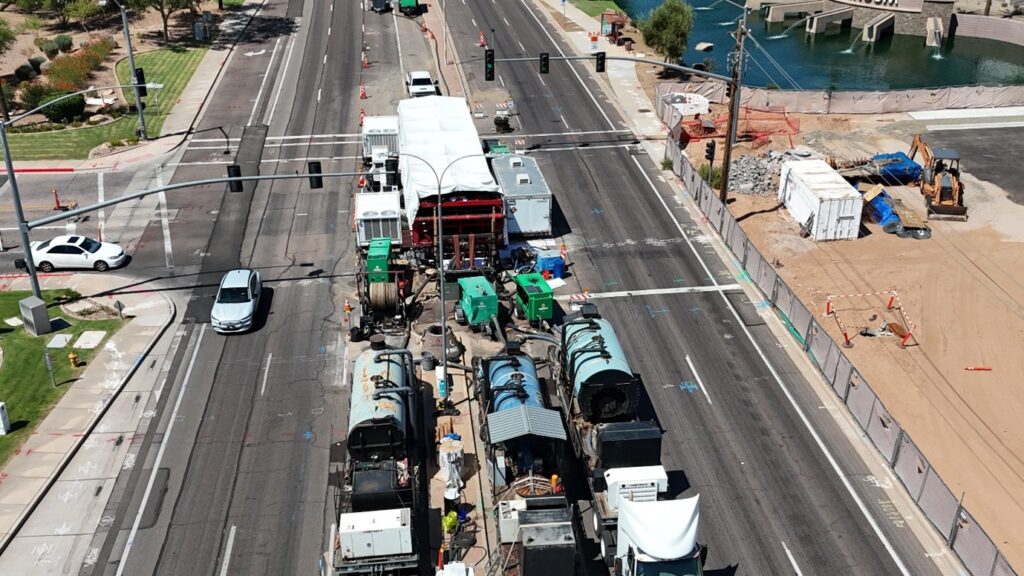
Maintaining adequate sewer capacity was an ongoing focus. Dibble completed a hydraulic analysis for two alternative trenchless rehabilitation methods: slip lining and CIPP. Our team calculated the anticipated liner thickness and its impact on capacity. To limit the reduction in capacity, CIPP was selected as the rehabilitation methodology. The liner manufacturer submitted a specific calculated thickness as part of the contractor submittal. After installation, the team verified the thickness of each segment. The finished product was 39 millimeters (1.53 inches) thick, resulting in a minimal decrease in pipe diameter that continues to provide the critical capacity the city needs.
Manhole Rehabilitation
Like the 66-inch sewer, the associated 48-inch and 60-inch concrete manholes also showed signs of deterioration. The team coordinated with B&F to determine the construction impacts of replacing the manholes, which would increase costs (compared to rehabilitation) and require a 16-foot by 16-foot trench box at each manhole. Excavation would also require significant utility coordination. Dibble provided a potholing list and held conflict review meetings to confirm affected utilities, including nitrogen gas, electrical, fiber optic, and irrigation lines.
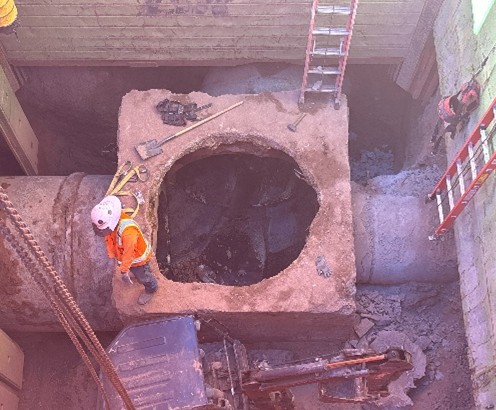
The city made a strategic decision to add 16 new polymer concrete manholes and one polymer concrete insert to the rehabilitation program. While this increased construction costs by approximately 10 million dollars and extended the schedule by about six months, this forward-looking change reduced lifecycle costs and stakeholder impacts while improving corrosion resistance and extending the service life by more than 50 years.
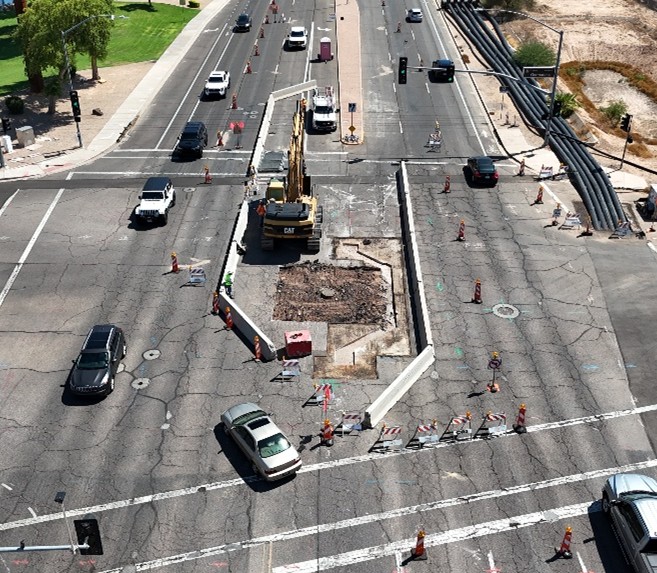
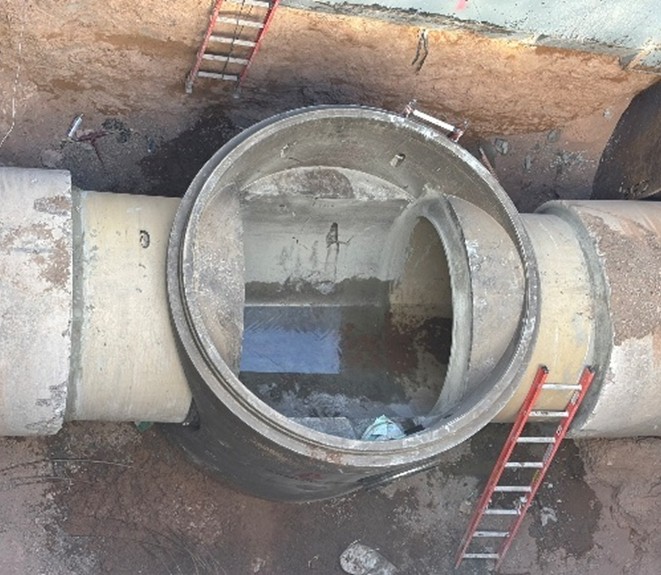
16-Foot Junction Structure
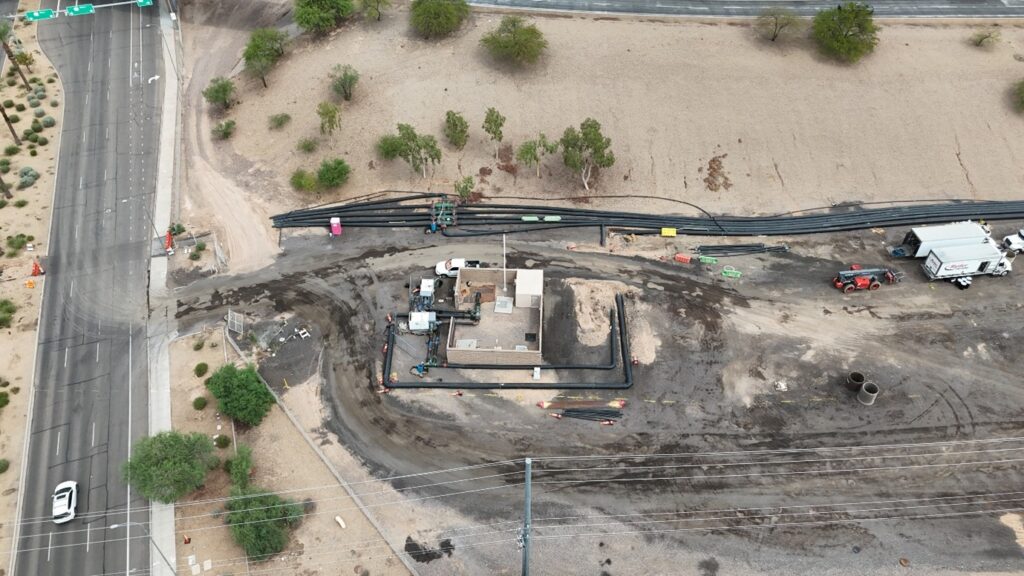
In anticipation of a future sewer connection, the team designed a custom 16-foot diameter polymer concrete junction structure at the upstream side of the project. This innovative structure includes corrosion-resistant fiberglass reinforced polymer (FRP) slide gates, enabling the city to divert flows between the existing and future sewer for maintenance or operational shutdowns. Dibble designed the structure to direct flows with appropriate velocities and keep turbulence at bay—promoting smooth flow and reducing the production of corrosive H2S gas.
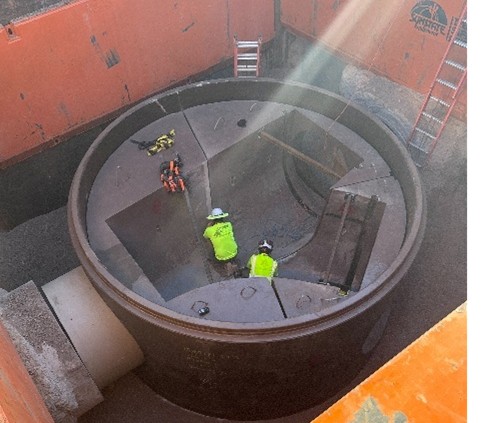
Facilitating safe operations and maintenance was a key focus in the design. Dibble worked with the city to develop standard diversion procedures and to design the structure’s lid to include a davit crane base, enabling the city to operate the large access hatch with a davit crane. The structure also includes removable FRP grates for operations and access. Collaboration with B&F was essential during diversion structure design, providing additional forethought into how the structure could be transported and built. Extensive manufacturer and contractor submittals provided the basis for confirming the design was feasible and technically sound.
FRP Termination Seals
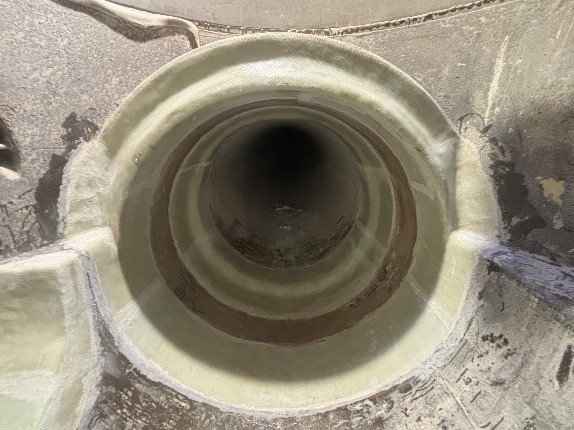
Sealing the CIPP terminations—the unfinished ends of the CIPP lining—is an important consideration for CIPP sewer projects. While CIPP rehabilitates and strengthens the existing sewer host pipe, insufficient termination seals could allow wastewater to seep between the liner and the host pipe, allowing corrosion to occur and potentially creating a weak point in the system. Dibble’s structural engineering team has developed a solution for this issue: FRP terminations. This innovative material provides a watertight seal with a lifespan that complements the lifespan of CIPP lining, creating a long-term structural connection with no mechanical parts. FRP terminations withstand groundwater pressure and are chemically compatible with both CIPP liner and the new/rehabilitated polymer manholes, resulting in a resilient, holistic solution.
Extensive Bypass Pumping
Planning and implementing the extensive temporary bypass pumping system was a significant effort. B&F’s construction team bypassed 20 million gallons per day (MGD) for more than two miles. In the northern portion of the project, five 18-inch HDPE bypass lines were buried just below the asphalt travel lanes to maintain traffic flow during construction. These 18-inch lines transitioned to three 24-inch HDPE pipes outside the roadway right-of-way in the southern portion of the project. The operation took months to plan and install and required numerous quantities and stats, careful evaluation of flow rates and routing, odor control, extensive traffic control, and significant coordination with the CMAR contractor and stakeholders.
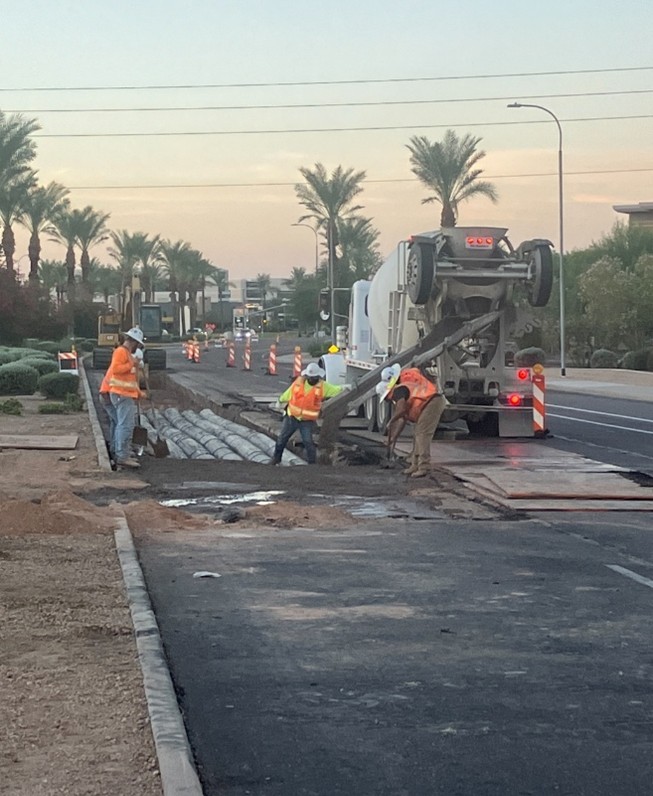
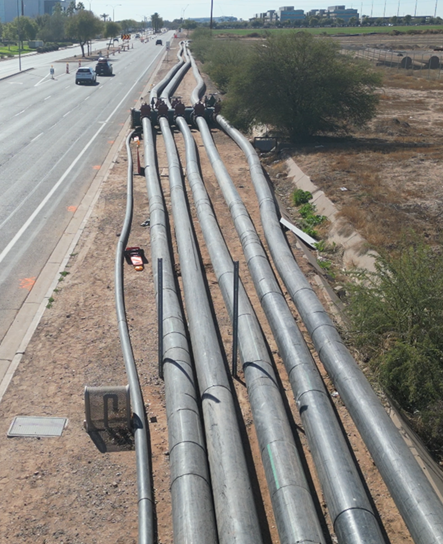
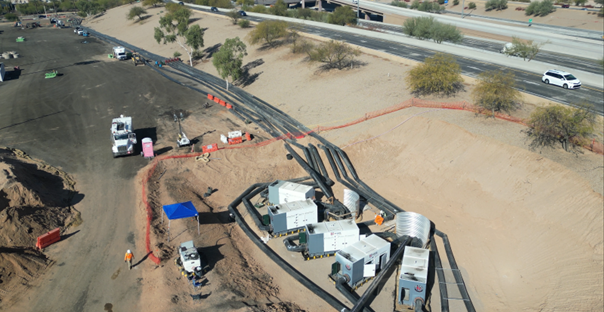
staged near SR 202
One particular challenge was diverting the flow from a 28-inch force main that discharged into the 66-inch sewer. To minimize service disruption, the team had a strict four-hour window to complete the bypass installation. The team met the challenge by developing and implementing a detailed diversion and bypass installation plan. Before the diversion window, the team mobilized resources and crews and brought in additional parts to minimize the chance of delays, resulting in a successful installation.
Schedule and Cost Control
Managing the schedule and costs for this important project required extensive coordination throughout design and construction. During preconstruction, B&F completed a detailed scheduling analysis and provided a cost-loaded schedule that linked activities with budget and resource allocations. To maintain progress, multiple construction activities needed to occur simultaneously, including the CIPP lining, manhole excavation, and surface restorations. Meticulous preconstruction planning of this work sequence prepared the way for success. During construction, the team tracked daily production rates and held weekly construction meetings and monthly program meetings to manage change and keep the project on track.
A Benchmark for Large-Diameter Sewer Rehabilitation
The successful rehabilitation of the city’s 66-inch sewer demonstrates how trenchless technology can efficiently extend the service life of large-diameter infrastructure. Through collaborative CMAR delivery, this project addressed multiple challenges with minimal service interruptions. Innovative design solutions, including CIPP liner, polymer concrete manholes, a custom polymer concrete junction structure, and FRP termination seals, provide lasting value with corrosion resistance. The team successfully bypassed 20 MGD of flow during construction and achieved long-term resilience. This case sets a benchmark for large-diameter sewer rehabilitation in heavily traveled, high-visibility metropolitan areas.
📄 Download the full case study PDF here


