

Future-Proofing Utah’s Airports: Funding, Electrification, and Advanced Air Mobility
Utah’s 46 public-use airports are being asked to do more with less—stretching limited funding while preparing for the next generation of aviation. Airports want partners who can help them navigate funding, growth, safety, electrification, and community expectations, not just deliver projects.
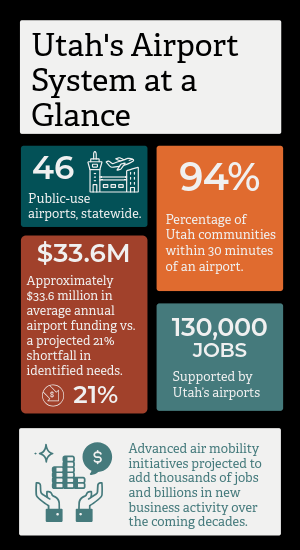
Utah airport hot buttons
Utah’s airports are at the center of some of the most important transportation conversations in the state. As passenger numbers climb, communities expand, and new aviation technologies move closer to real-world deployment, airports of all sizes are being asked to do more with limited space, funding, and staff capacity.
Outside of Salt Lake City International, Utah’s airport system plays a vital role in business travel, air medical access, wildfire response, flight training, tourism, and regional connectivity. Statewide planning underscores that a strong airport system is essential for residents, employers, and visitors, while also pointing to roughly $33.6 million in average annual funding and a projected 21% shortfall for needed improvements.
That pressure is especially visible along the Wasatch Front and in southern Utah, where airports must support both today’s operations and tomorrow’s aviation ecosystem.
From electric cargo and fully electric training fleets to emergency-response drones, search-and-rescue missions, and future passenger air taxis, Utah airports are preparing for a broader range of users, infrastructure needs, and community expectations.
At Dibble, we see airports as essential public works assets that support public safety, economic activity, and long-term resilience across the West. In Utah and neighboring states, sponsors are navigating a complex mix of operational needs, regulations, community interests, and funding realities. They need partners who understand how airports operate day-to-day and can help them make informed, phased decisions over time.
Getting the numbers right: funding, ACIP, and phasing
Across Utah, Arizona, and Colorado, airports are being asked to do more with finite dollars. As the list of necessary projects grows—runway rehabs, safety-area improvements, electrical upgrades, new hangars, and now charging and vertiport-ready sites—thoughtful planning becomes critical. When cost estimates miss the mark, it can derail an Airport Capital Improvement Program, strain relationships with local leaders, and put future funding at risk.
That is why accurate cost estimating, value engineering, and a well-sequenced ACIP strategy are essential. Airport managers want reliable data from their consultants: clear construction estimates, realistic escalation assumptions, and phasing that builds trust with decision-makers.
Dibble has helped clients build that flexibility. At Glendale Municipal Airport, our multi-year Apron Reconstruction & Taxiway Realignments program was structured to align with FAA and Arizona DOT funding cycles. By phasing the work and carefully scoping bid packages, the City could deliver needed improvements while matching each phase to available grant resources.
At Prescott Regional Airport, our Taxiway Charlie Relocation and Hot Spot Mitigation project was sequenced across multiple years to deliver meaningful safety and geometry improvements in a funding environment that could not support the full project at once. For Utah airports, the principle is the same: strong planning, realistic phasing, and a clear funding strategy help every dollar go farther.

Balancing growth, safety, and expectations
Rapid population growth in the Mountain West is putting pressure on airfield capacity, hangar space, and surrounding land uses. Communities want improved services and expanded access, but airports must remain safe, compliant, and operational while projects move forward. That creates a constant tension: “we need more, faster” versus “we must stay safe and compliant.”
We see that tension across the region. At the Durango–La Plata County Airport Program, Dibble supported a major runway rehabilitation at a commercial service airport and helped phase construction around airline operations and community needs. At Prescott Regional Airport, our Taxiway Charlie work addressed FAA-identified hot spots and operational safety concerns at an airport serving overlapping training, commercial, and general aviation demands.
Utah airports are navigating the same realities. Fast-growing communities are asking for more hangar capacity, better passenger experiences, and more direct connections, even as the same runways and safety areas carry increasing demands. The right partners help sponsors think through construction phasing, temporary operations, and stakeholder communication so critical safety and capacity projects can move forward with minimal disruption.
Planning for electrification and advanced air mobility

Utah is poised to lead air mobility growth.
Utah airports are also planning for emerging needs such as aircraft electrification, advanced air mobility, and drone integration. That includes potential infrastructure for electric cargo operations, fully electric flight-training aircraft, emergency-response and search-and-rescue drones, and eventual passenger air taxis tied to major events and long-term mobility goals.
The state is already leaning into that future. Advanced air mobility planning highlights airports as prime locations for early deployment and notes that many Utah airports are beginning to plan for electrification, vertiports, and related support systems. That planning extends beyond aircraft to practical infrastructure decisions: power availability, charging locations, apron and staging layouts, access, weather systems, and communications networks that can support new operations over time.
Utah’s uFLY coalition has been selected as one of a limited number of national projects in a federal eVTOL and advanced air mobility integration program, underscoring that these technologies are moving from concept to implementation. For airport managers, the question is no longer whether to plan—it is how to plan in a way that is grounded, phased, and aligned with their community’s risk tolerance and capital constraints.
Future-proofing looks different for every airport, but the foundational questions are consistent. How will new aircraft types interact with existing operations? Where will they stage, load, charge, or land? What does the local electrical grid actually support today, and what upgrades will be needed tomorrow? How can airports and heliports be positioned to support both aviation and broader community resilience?
These are the questions we are helping sponsors work through as Utah’s airport and aviation partners move beyond visioning into implementation. Our team recently attended the 47G Project Alta Summit, which brought together leaders across aerospace, infrastructure, energy, and public policy to accelerate the deployment of advanced air mobility in Utah. That conversation reinforced what we are already seeing: airport electrification and heliport planning are becoming more central to airport conversations, especially where emergency response and regional access are part of the long-term picture.
Making the case to councils and boards
Another hot button is communication. Airports are part of the same public works system as streets, water, and drainage, but their value is not always visible to elected officials, boards, or nearby residents. Airport managers may know exactly how their facilities support medevac missions, wildfire response, flight training and workforce development, tourism, and business attraction—but that story doesn’t always reach decision-makers in a clear, compelling way.
Utah’s airport system supports significant statewide economic activity, and smaller airports provide critical access for rural and regional communities. When those contributions are paired with real-world stories and clear visuals, conversations about funding, land use, and future investment become more productive. Impact studies are important, but they only help if someone is there to translate them into examples that resonate with councils and county commissions.
This will matter even more as Utah prepares for its next chapter. Discussions around major events, regional mobility, air cargo, and future air-taxi operations will create new pressure on ramp space, hangar capacity, charging infrastructure, and surrounding development patterns. Airports need partners who can translate technical needs into stories, graphics, and phased strategies that resonate locally.
At Dibble, we see that communications piece as part of our responsibility. Helping sponsors frame the “why” behind a project—why this safety area matters, why this apron needs to be reconstructed now, why this electrical upgrade sets the stage for future technologies—can be just as important as the drawings and specifications.
Partnering for Utah’s next chapter
Underneath all of these hot buttons—funding, growth, safety, future technologies, community understanding, and operational complexity—is a common theme: airports want partners, not just projects. They are looking for teams who will walk through the entire lifecycle with them, from early ACIP concepts and community conversations through design, construction, and long-term performance.
Dibble’s airport development team is committed to that kind of partnership in Utah and across the West. By combining solid data, clear communication, and a deep understanding of how airports operate day to day, we help clients plan wisely, phase improvements strategically, and build safe, efficient, and economically vibrant facilities ready for today’s needs and tomorrow’s opportunities. If you’re wrestling with ACIP planning, project phasing, electrification, heliport strategy, or how to make the case.
If you’re wrestling with ACIP planning, project phasing, electrification, heliport strategy, or how to make the case for your next airport investment, we’re ready to help start the conversation.


